Tork-Tite® feet explained: why a diaphragm valve should have a hard stop
Tork-Tite® feet are machined stops on Aquasyn diaphragm valve bonnets. When the bonnet is bolted down, and again when the handwheel closes the valve, the feet land metal-to-metal and set how far the diaphragm is compressed. The operator turns until it stops. The diaphragm ends up at the same compression every time, which takes over-tightening out of the list of ways a diaphragm can fail and lets the valve go from open to closed in less than one turn of the handwheel.
The rest of this note covers why compression is what actually wears out diaphragms, how a hard stop differs from closing by feel or by torque, and what changes for the people who run and maintain the valves.
Diaphragms fail from squeeze, not pressure
A diaphragm valve seals in two places. The perimeter of the diaphragm is clamped between bonnet and body, and that's the seal to atmosphere. The center is pushed down onto the weir by the compressor, and that's the shutoff. Both depend on the elastomer being compressed by the right amount. Too little and it leaks. Too much and it seals perfectly for a while, then pays for it.
EPDM squeezed too hard takes a compression set. It deforms permanently and stops pushing back against the surface it's sealing on. Heat speeds this up, so steam makes it worse. After a handful of SIP cycles, an over-squeezed EPDM diaphragm has a flat groove where the weir sits, and the only way to make it seal again is to squeeze harder, which deepens the groove. You can watch this happen on a valve that needs a little more handwheel every week.
PTFE-faced diaphragms fail differently. PTFE cold-flows under sustained load, so an over-compressed face slowly thins along the weir contact line and around the bolt circle. Eventually it cracks, usually where the face flexes between open and closed. A PTFE diaphragm that looks like it died from cycling has often been crushed first.
In both cases the diaphragm could have handled the line pressure for far longer. How hard it was squeezed is what set its life.
The trouble with closing by feel
A manual diaphragm valve without a stop closes when the operator decides it's closed. Some stop at the first firm resistance. Some keep going until the handwheel won't move, and some keep a short length of pipe near the manifold for exactly that purpose. Every plant has one of those pipes. Nobody ever admits it's theirs.
Bonnet bolts have the same problem on a longer timescale. Conventional bonnets come with a bolt torque table by size and diaphragm material, and the usual guidance is to recheck torque after the first sterilization cycle, because the elastomer relaxes as it heats and the bolt preload drops along with it. That recheck has to compete with everything else on the maintenance list that shift.
Then there's the drain angle. Hygienic diaphragm valves are installed rotated to their drain angle, so the bonnet isn't square to gravity and the diaphragm doesn't see even compression all the way around (How diaphragm valves work goes through this in detail). An unevenly tightened bolt pattern adds to it.
None of this is unusual. It's simply what happens when the seated position is left to judgment.
What the feet actually do
Tork-Tite feet take that judgment out of the operator's hands and put it into the machining.
There are two stops. On the bonnet, machined feet at the corners land on the valve body as the bonnet bolts are tightened. Once they're down, the bonnet is clamped metal-to-metal and the diaphragm perimeter is compressed by a fixed amount, set by the height of the feet relative to the diaphragm seat. Tightening the bolts past that point loads the feet. The diaphragm doesn't see it.
The second stop acts from the handwheel side. The compressor is machined to match the weir profile, and its travel ends at a fixed position. Turning the handwheel closed drives the diaphragm down to its designed seated position on the weir, and then the handwheel stops. That stop is the signal the valve is closed.
The feet are machined to the weir profile to within a thousandth of an inch. That tolerance is what makes the idea work at all. Seated compression is now the sum of the body, diaphragm and bonnet dimensions, so each of those has to be held tightly or the stop is just setting the wrong compression consistently.
If this sounds familiar from flange design, it should. An O-ring in a groove on a flange that closes metal-to-metal works the same way: the groove depth sets the squeeze, and the bolts only have to hold the faces together. The useful side effect is where the bolt load goes. It runs through the feet rather than through the rubber, so when the elastomer relaxes during a steam cycle it doesn't take the bolt preload with it. On a valve that swings between steam and cold buffer every batch, that matters more than almost anything else about the bonnet.
The body side has a matching feature. Aquasyn bodies have an Integral Sealing Ridge machined between the bore and the bolt holes, and when the bonnet lands on its feet the diaphragm is pressed against that ridge. The seal line is defined by the machining, not by how evenly the bolts happened to be pulled down.
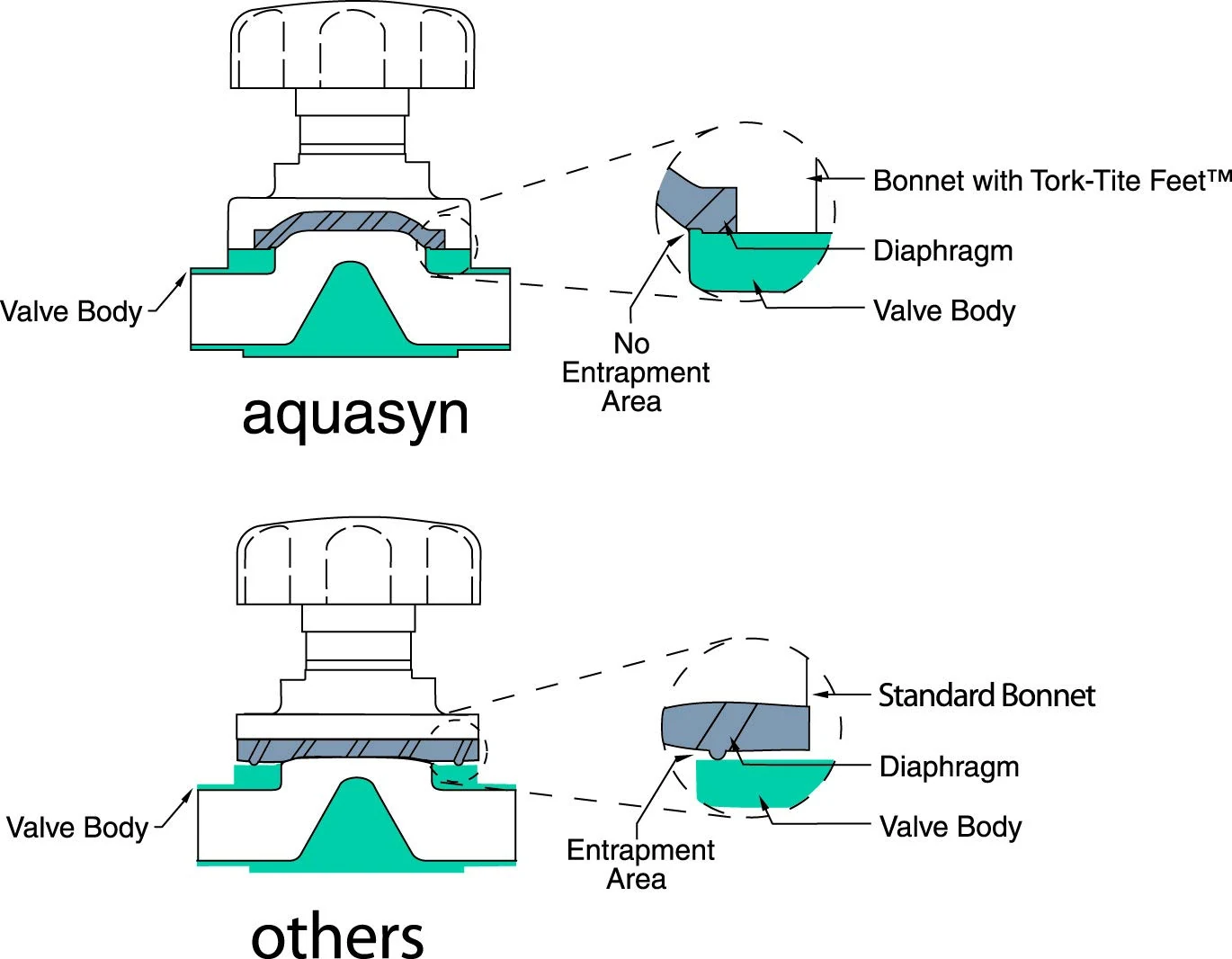
Why it closes in under a turn
Handwheels on valves without a stop usually take several turns from open to closed. The fine thread gives the operator mechanical advantage, and more importantly a slow approach to the seat so they can feel for it. The thread is doing a second job as a gauge.
With a hard stop, it doesn't need to. The end position is fixed in metal, so the thread lead can be coarse enough to take the compressor through its full stroke in less than one turn. It's faster, and it's much easier to check on a walkdown. The handwheel is either at the stop or it isn't, and the position indicator on the standard bonnet shows which.
On a manifold with twenty-odd valves, fewer turns is a real ergonomic win. It's still the lesser benefit. The bigger one is that "closed" means the same thing on every valve, on every shift, regardless of who closed it.
What changes for operators and maintenance
Turn until it stops
That's the whole closing procedure. Force past the stop doesn't compress the diaphragm any further; it loads the threads and the feet. The pipe extension can go in the scrap bin.
A leak at the stop isn't fixed by tightening
This is the biggest change in troubleshooting, and the one that takes longest to sink in. On a valve without a stop, "give it another quarter turn" is the reflex, and it works right up until it ruins the diaphragm. With a hard stop, compression at the stop is already correct. A leak there points somewhere else: a worn or set diaphragm, a diaphragm that doesn't belong in that bonnet, product buildup or debris on the weir, or a damaged weir crown. Pull the diaphragm and look at it before anything else.
Diaphragm changes get simpler
The bolts go down in a cross pattern until the feet land, so the bonnet seats evenly. Seated compression comes from the feet, not from a torque value you have to look up for each size and material.
Match the diaphragm to the bonnet
The stop sets correct compression for the diaphragm it was designed around. A diaphragm of a different thickness or construction, including one from another manufacturer that happens to fit the bolt pattern, changes the stack and changes the compression with it. The diaphragm materials page lists what's designed for these bonnets.
Actuated valves
Pneumatic actuators have their own version of the problem. An actuator closes with whatever force the air pressure or spring gives it, and that force doesn't ease off when the diaphragm softens at temperature. Aquasyn's pneumatic and eMaxion™ electric actuators mount on the same Tork-Tite bonnet interface as the manual line, and the pneumatic actuators have an integral controlled travel stop, so the diaphragm sees the same closed position under air as it does by hand. Details are on the actuation page.
Frequently asked questions
What are Tork-Tite® feet?
Tork-Tite® feet are machined hard stops on Aquasyn diaphragm valve bonnets. They land metal-to-metal and fix how far the diaphragm is compressed, both when the bonnet is bolted to the body and when the handwheel closes the valve.
Do I need a torque wrench to close a Tork-Tite valve?
No. Turn the handwheel until it stops. The stop sets the seated compression, and extra force past it doesn't squeeze the diaphragm any further.
What causes premature diaphragm failure in a diaphragm valve?
Over-compression is one of the most common causes. EPDM takes a permanent compression set, especially under steam, and PTFE cold-flows and thins along the weir line until it cracks. Both get worse when valves are closed by feel.
Why does my diaphragm valve leak when it's closed?
On a valve with a hard stop, a leak at the stop usually means a worn or set diaphragm, the wrong diaphragm, debris on the weir or a damaged weir crown. More force won't fix it. On a valve without a stop, overtightening to cure one leak is a common cause of the next.
Do diaphragm valve bonnet bolts need re-torquing after SIP?
On a conventional bonnet, the elastomer relaxes with heat and bolt preload drops, so a torque recheck after the first sterilization cycle is standard practice. On a bonnet that clamps metal-to-metal, the bolt load runs through the stops rather than the elastomer, so relaxation doesn't unload the bolts the same way. Follow the IOM for the specific valve.
Do Tork-Tite feet work with PTFE diaphragms?
Yes. The feet are on every Aquasyn bonnet and are used with EPDM, PTFE-faced, silicone and Viton diaphragms. PTFE-faced diaphragms arguably gain the most, because their main failure mode, cold flow, is driven by sustained over-compression.
Build a two-way body
Size, material, finish, end connections, diaphragm and operation. The configurator only offers combinations that can actually be built.
Open the configurator →