Diaphragm materials.
The valve body decides the geometry. The diaphragm decides whether the valve survives your chemistry. Four compounds, one compatibility matrix, and replacement elements stocked for every size Aquasyn builds.
The four materials.
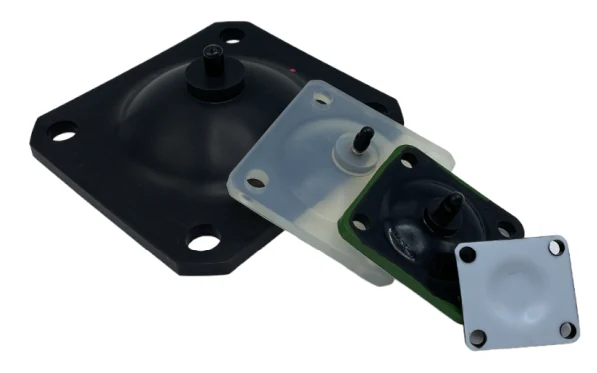
EPDM, PTFE-faced TFM 1700, silicone and Viton. Every Aquasyn valve size is stocked in all four, so the compound is a specification decision rather than a lead-time decision.
Pick the diaphragm against the most aggressive thing it will ever touch. In hygienic service that is almost never the product. It is the caustic wash, the pure steam at 250°F, or the passivation acid that runs through the same line once a quarter. A compound that shrugs off the buffer and then hardens in the CIP cycle will still fail, and it will fail at the point in the schedule where a shutdown costs the most.
The ranges below are continuous-service envelopes, not peak survival numbers. Short SIP excursions above the stated ceiling are tolerated on all four. Sitting at the ceiling for a shift, every shift, is a different question, and one worth putting to engineering with the actual duty cycle rather than the worst-case number from a datasheet.
- Best for
- WFI, purified water, broad-pH hygienic process, steam and caustic CIP/SIP
- Avoid
- Aggressive solvents, mineral oils, hydrocarbons
- Temp
- −60°F to 285°F continuous
(TFM 1700)
- Best for
- Aggressive or mixed chemistries, solvent exposure, low extractables
- Avoid
- High-frequency cycling under high pressure
- Temp
- 0°F to 300°F continuous
- Best for
- High-temperature service, FDA food and pharma contact, cold-side duty
- Avoid
- Solvents, hydrocarbons, concentrated acids
- Temp
- −75°F to 400°F continuous
- Best for
- Solvent service, hydrocarbons, mineral oils and fats, low extractables
- Avoid
- Strong amines, ketones, hot caustic
- Temp
- 0°F to 400°F continuous
Chemical compatibility.
Eleven chemistry classes against the four stocked compounds. Read it as a shortlist generator, not a release document: it narrows four options to one or two, and then the real fluid gets reviewed.
| Chemistry class | EPDM | PTFE-faced (TFM 1700) |
Silicone | Viton (FKM) |
|---|---|---|---|---|
| WFI & purified water | A | A | A | B |
| Buffers & culture media | A | A | A | B |
| Steam / SIP | A | A | B | B |
| Caustic (NaOH) CIP | A | A | B | C |
| Nitric / phosphoric CIP | B | A | C | A |
| Alcohols (IPA / ethanol) | A | A | A | A |
| Aromatic hydrocarbons | C | A | C | B |
| Mineral oils & fats | C | A | C | A |
| Amines & ketones | C | A | C | C |
| Hot dry service above 300°F | C | C | A | A |
| Cold service below −40°F | B | C | A | C |
Two rows deserve a note. Nitric and phosphoric CIP are grouped, but nitric is the limiting case of the pair: phosphoric alone would lift EPDM to an A. And the steam row assumes pure steam at conventional SIP conditions. Superheated steam, or SIP cycles that run long and frequent, pull silicone and Viton down further than the letter suggests.
Mixed solvent streams, unusual concentrations, elevated temperature combined with an aggressive wash, or anything the matrix rates B where a failure would be expensive: send it to engineering with the process fluid MSDS, the temperature, and the cycle frequency. That is enough to give a real answer rather than a letter grade. Talk to engineering or email sales@aquasyn.com.
Molded in the open position.
A diaphragm that leaves the mold already deformed toward the weir spends its whole life fighting that shape. Aquasyn molds in the open position, so the relaxed state and the open state are the same state.
The reasoning is simple enough to check on a bench. An elastomer takes a compression set in whatever shape it cures in. Cure it closed and the sealing bead is pre-stressed the moment it leaves the tool, before it has sealed anything, and every opening stroke is working against that stored stress. Cure it open and the compound is only asked to deform when the valve is told to close. Over thousands of cycles that difference shows up as a bead that is still dimensionally where it started.
Two other parts of the valve do as much for diaphragm life as the compound does, and neither of them is the diaphragm.
Molding & tolerance
- Molded in the open position · relaxed state is the open state
- Approved compounds only, cured to a controlled profile
- Sealing bead and mounting features molded, never trimmed to size
- Every lot carries a Certificate of Conformance and lot ID
- Mating face in the body finished to 10–25Ra on five-axis centers in Carson City
What actually sets service life
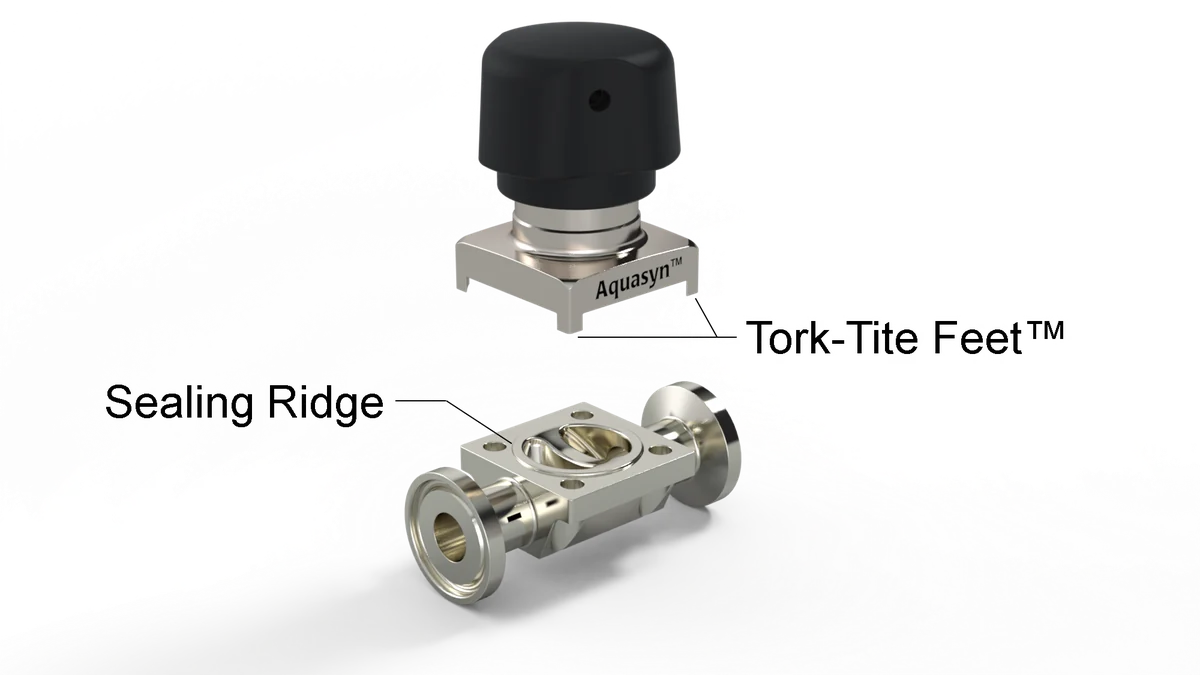
- Tork-Tite® feet cap the compression: the handwheel turns until the feet make metal-to-metal contact with the body, and stops
- Same compression on every cycle, regardless of who closed the valve
- Integral Sealing Ridge moves the primary seal into the body, so the diaphragm flexes and the body seals
- No entrapment pocket between diaphragm and body, so no seal drift and no hidden extractables path
- Cycle frequency, temperature and pressure differential do the rest · ask engineering for an interval against your duty, not a catalog number
The failure we see most. Not chemical attack. Over-tightening. An operator closes a manual valve, feels no hard stop, and keeps turning until it feels sealed, which crushes the bead and takes a permanent set out of it. The next close leaks, so the next operator turns harder. Tork-Tite® feet end that loop by putting a physical stop in the mechanism, which is why they are on every bonnet rather than offered as an option.
Flow and drain data.
Cv curves and self-drain geometry for the standard two-way family. Size a valve against a specified flow rate at a given pressure drop, and confirm that an installed valve will drain at the orientation it is going into.
| % Open | ½" | ¾" | 1" | 1½" | 2" |
|---|---|---|---|---|---|
| 10% | 0.5 | 1.1 | 1.4 | 4.0 | 7.6 |
| 20% | 1.0 | 2.0 | 2.1 | 9.3 | 16.5 |
| 30% | 1.4 | 3.7 | 4.3 | 14.2 | 22.3 |
| 40% | 1.7 | 4.3 | 6.9 | 18.9 | 27.5 |
| 50% | 1.9 | 4.8 | 8.8 | 22.0 | 35.6 |
| 60% | 1.9 | 5.0 | 10.9 | 25.0 | 43.5 |
| 70% | 2.0 | 5.0 | 13.1 | 28.9 | 48.2 |
| 80% | 2.3 | 5.4 | 14.2 | 34.0 | 54.3 |
| 90% | 2.6 | 6.0 | 15.6 | 37.8 | 58.6 |
| 100% | 3.0 | 6.8 | 17.3 | 43.6 | 66.0 |
Figures are for the standard two-way body with a stocked diaphragm fitted. Note the ½" and ¾" curves flattening between 50% and 70% open: on the small sizes the weir, not the stroke, is already the restriction, so throttling in that band buys very little flow for a lot of travel.
| Size | Angle | Size | Angle |
|---|---|---|---|
| ¼" | 41° | 1" | 30° |
| ⅜" | 30° | 1½" | 25° |
| ½" | 25° | 2" | 23° |
| ¾" | 18° | All standard two-way bodies | |
Alignment marks are etched on every end connection, so the installer can set the angle by eye and verify it against the body rather than measuring. Check orientation before tack-welding into the line: it is the cheapest possible moment to catch it, and a valve welded in at the wrong roll angle holds a pool that no CIP recipe will reach.
Replacement and refurbishment.
Replacement diaphragms are stocked for every valve size Aquasyn builds, in all four compounds. The diaphragm is a wear part. It is meant to be changed, and the valve is built so that changing it is a field job rather than a return.
Most calls about a diaphragm order stall on the same two questions, so they are worth answering before you pick up the phone: what size is the valve, and what is the current element made of. With those two the order is straightforward. Without them, someone at your plant is measuring a valve with a tape while the line is down.
Signs it is time to replace
- A close that needs more handwheel travel than it used to, or more than the valve next to it
- Weeping at the bonnet joint after a SIP cycle, clearing as the line cools
- Visible set in the sealing bead: the compound no longer springs back when the bonnet is lifted
- Hardening, chalking or a glazed look on the wetted face
- Swelling · the element no longer drops cleanly into its seat
- A chemistry change upstream that the current compound was never specified against
What ships with every replacement
- Certificate of Conformance for the compound
- Lot traceability, identical to a new-valve element
- USP Class VI and FDA 21 CFR 177.2600 documentation on request
- Compound and size marked on the part, so the next person does not have to guess
Field change · notes
- Depressurize and drain the line. A diaphragm under differential is holding more than it looks like it is holding
- Back the bonnet off evenly, lift the old element out, and look at the body seat before fitting the new one
- Seat the new diaphragm dry unless engineering has specified otherwise
- Re-torque until the Tork-Tite® feet make metal-to-metal contact with the body, then stop. The stop is the specification: there is no torque figure to look up and no shim stack to build
- Cycle the valve once by hand before returning it to service, and re-check the bonnet joint after the first SIP
Certifications and documentation.
Every stocked compound in every stocked size carries the same three standards. Not a selected subset, not a premium grade, not an option at order. This section is the reference the rest of the Aquasyn product pages point at.
Biological reactivity testing for plastic components in contact with product. Held on EPDM, PTFE-faced TFM 1700, silicone and Viton alike, across the full size range.
Hygienic process equipment: surface finish, material chemistry and dimensional practice. The body side of the joint is machined and finished to the same standard the diaphragm is certified against.
Rubber articles intended for repeated food contact, extractables testing passed. This is the clause a food and beverage or cosmetics auditor will ask for by number.
Additional documentation is available at order or afterwards: weld logs on fabricated assemblies, electropolish records, surface finish profilometer readings, FAT and SAT packs, and validation templates aligned to IQ and OQ. Ask for it with the order if you know you will need it, and ask afterwards if you find you do.
Know the size, know the material.
That is the whole order. Every size in all four compounds is stocked in Carson City, and the tag number or GA drawing, if you have one, removes the rest of the questions.