CIP explained: what clean-in-place does, and where it fails
Clean-in-place (CIP) cleans a process system without taking it apart. Water and cleaning solutions are pumped through the same tubing, valves and vessels the product runs through, in a fixed sequence, at a set temperature, concentration, velocity and time. Done well, it removes product residue to a level you can prove, the same way, every time. It does not sterilize anything, and it cannot clean a surface the solution never actually reaches.
That last limit is the one that catches people. Most CIP failures are not chemistry failures. They are geometry failures.
What CIP is, and what it isn't
Before CIP, hygienic lines were stripped down by hand, scrubbed, and rebuilt, a process now called clean-out-of-place (COP). Dairies automated it first, in the 1950s, and biopharma inherited the idea along with the stainless tubing.
CIP has one job: remove soil. That means product residue, protein, fat, sugar, cell debris, media, mineral scale, and the previous cleaning agent. It is not the step that kills organisms. Three separate words get blurred here, and a specification should keep them apart:
- Cleaning removes soil. This is CIP.
- Sanitizing cuts the microbial load to a safe level, usually with hot water or a chemical sanitizer after cleaning. Common in food and beverage.
- Sterilizing kills everything viable. In biopharma that is normally steam-in-place (SIP), run after CIP.
The order matters. Steam will not penetrate a film of soil, and sanitizer is spent on residue rather than on organisms. A system that does not clean will not sterilize either, however long the steam hold.
Four variables, traded against each other
In 1959 Herbert Sinner, a chemist at Henkel, described cleaning as the product of four factors: temperature, chemistry, mechanical action and time. In a closed pipe, mechanical action means flow. The point of Sinner's circle is the trade: reduce one factor and at least one of the others has to grow to deliver the same clean.
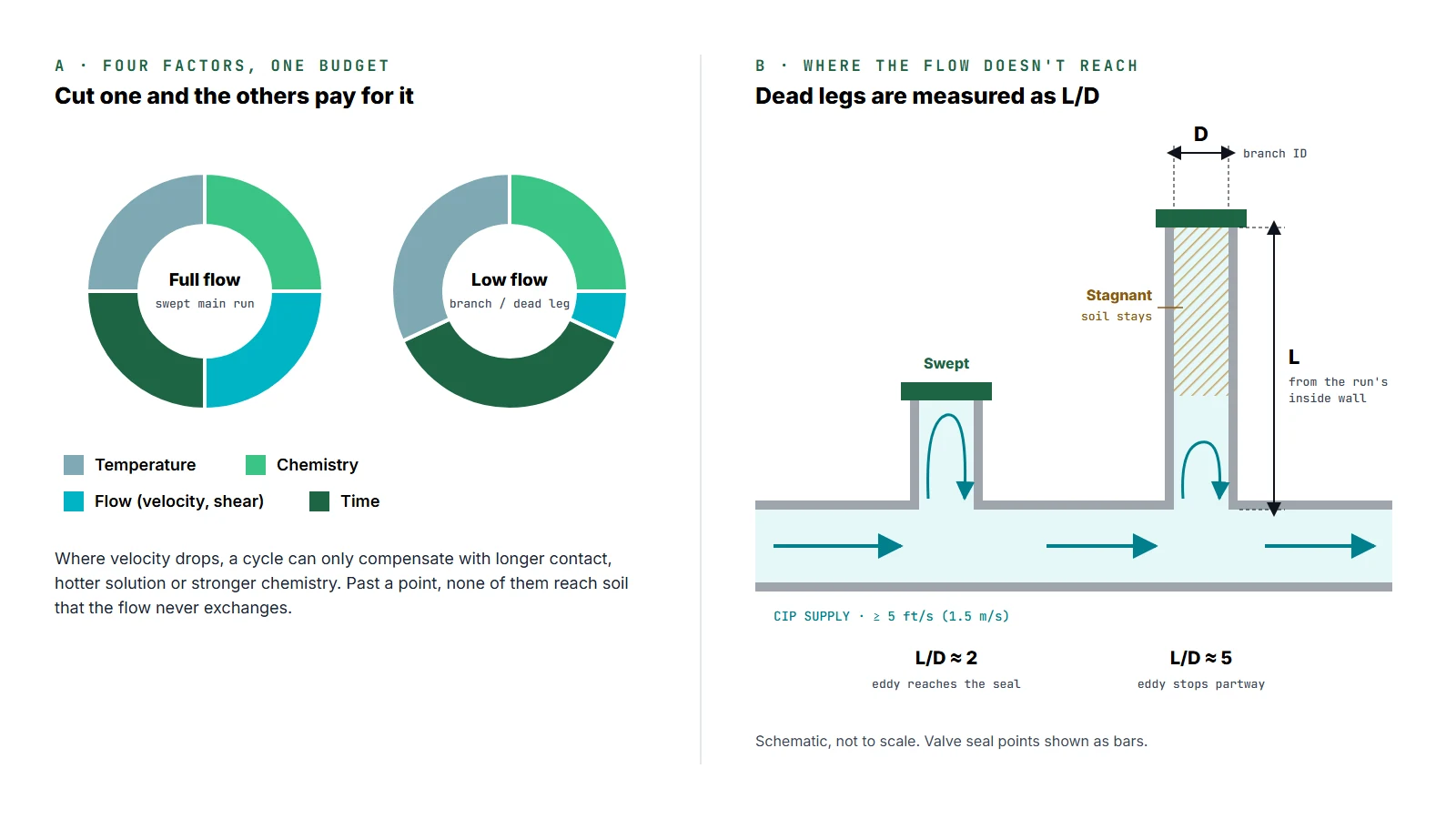
Panel B is the reason this note exists. Temperature, chemistry and time can all be raised from the control room. Flow inside a branch cannot, because it is set by the shape of the pipework.
Temperature
Heat softens fats, speeds the chemical reactions that break soil down, and lowers the viscosity of the film you are trying to shift. As a rough rule, reaction rates about double for every 10 °C. Caustic washes typically run at 60 to 85 °C (140 to 185 °F).
Hotter is not always better. Protein soils denature as they heat, and a denatured protein film bonds to stainless far more tightly than the native one. That is why the pre-rinse is run cold or lukewarm: you want to flush loose protein out before anything hot reaches it. A plant that "improves" its cycle by heating the pre-rinse can end up baking on the soil it used to remove.
Temperature also sets the life of every elastomer in the circuit. A diaphragm or gasket compound that is fine with a given caustic at ambient may be marginal at 80 °C.
Chemistry
Each agent targets a type of soil. Most cycles use an alkaline wash for organics, then an acid wash for minerals.
| Agent | Typical use | Removes | Watch for |
|---|---|---|---|
| Sodium hydroxide (caustic) | 0.5 to 2%, 60 to 85 °C | Proteins, fats (by saponification), most organics | Does not remove mineral scale; tough on some elastomers when hot |
| Formulated alkaline detergent | Per supplier | As caustic, plus surfactants and chelants for wetting and hard water | Surfactants must rinse out; residue limits apply to them too |
| Phosphoric or citric acid | 0.5 to 1.5%, 50 to 70 °C | Mineral scale, milkstone, residual caustic | Citric is gentler and common in biopharma |
| Nitric acid | 0.5 to 1.5%, 50 to 70 °C | Mineral scale; also used in passivation | Aggressive on some elastomers; handling hazards |
| Peracetic acid, hot water | Ambient (PAA) or above 80 °C (water) | Nothing: these sanitize, they do not clean | Only effective on a surface that is already clean |
Water quality is part of the chemistry. Hard water consumes chelant and leaves scale; in biopharma the final rinses are normally purified water or WFI, so that the rinse itself does not leave something behind.
Flow
The number most specifications carry is a minimum of 5 ft/s (about 1.5 m/s) in every line of the circuit. It is a rule of thumb rather than a law of physics. At that velocity in a 1″ hygienic tube the Reynolds number is in the tens of thousands, comfortably turbulent, so the flow is scrubbing the wall rather than sliding along it.
What engineers underestimate is how fast the required flow grows with tube size, because flow scales with the bore area:
| Tube OD | Bore | US gpm | L/min |
|---|---|---|---|
| ½″ | 0.370″ | 1.7 | 6 |
| ¾″ | 0.620″ | 4.7 | 18 |
| 1″ | 0.870″ | 9.3 | 35 |
| 1½″ | 1.370″ | 23 | 87 |
| 2″ | 1.870″ | 43 | 162 |
| 3″ | 2.870″ | 101 | 382 |
| 4″ | 3.834″ | 180 | 681 |
The supply pump has to hit the velocity in the largest line in the circuit. When a circuit splits into parallel paths, the flow divides and so does the velocity, which is why CIP circuits are usually routed in series or switched path by path.
Vessels are different. A tank is cleaned by a spray device, and the usual sizing rule for a static spray ball is roughly 2.5 to 3 gpm per foot of vessel circumference. Coverage is checked once at commissioning with a riboflavin test, described in ASME BPE: coat the interior with riboflavin solution, run a rinse, and look for anything that still fluoresces under UV light.
Time
Contact time is the cheapest factor to add and the slowest to pay back. It helps where the solution is reaching the soil but not yet winning. It does nothing at all where the solution is not reaching the soil. A twenty-minute caustic wash that leaves a dead leg dirty will leave it dirty at sixty minutes.
A typical cycle, step by step
Sequences vary by industry and by soil, but most look like this:
- Pre-rinse. Cold or lukewarm water, often to drain, to flush out loose product. On a heavily soiled line this step removes most of what is there.
- Alkaline wash. Hot caustic or formulated detergent, recirculated, commonly 10 to 60 minutes.
- Intermediate rinse. Pushes out the caustic before the acid goes in.
- Acid wash. Optional, depending on water hardness and soil. Removes scale and neutralizes residual alkali.
- Final rinse. Purified water or WFI in biopharma, potable water in most food plants, run until the return meets an acceptance limit, usually conductivity.
- Sanitize or sterilize. A sanitizer, hot water, or SIP, depending on the process.
- Drain and, where specified, blow down. Standing rinse water is a growth medium.
The skid's control system records temperature, conductivity, flow and time for each step. In a GMP plant that record is what lets QA release the equipment.
Why valve geometry decides the result
Everything above can be set from a recipe screen. What follows cannot. It is fixed when the system is designed and when it is installed, and no cycle change will fix it afterwards.
Dead legs
A dead leg is a branch the flow does not exchange: a closed valve on a tee, an instrument port, a capped spare connection. The main run's turbulence throws an eddy into the mouth of the branch, and that eddy weakens with depth. Beyond it the solution sits, warms up, and does almost nothing.
Dead legs are expressed as a ratio, L/D. ASME BPE defines L as the length of the branch, measured from the inside wall of the main run, at right angles to the flow, to the sealing point, and D as the nominal inside diameter of the branch. The ratio usually quoted from BPE is 2 or less for product-contact systems. Food and dairy plants built to 3-A Sanitary Standards work from their own requirements, and meeting one does not mean you meet the other.
Older drawings and some site standards still carry a "6D" dead-leg limit. It comes from an FDA rule proposed for large-volume parenterals in the 1970s that was never finalized, and it measured from the centerline of the main pipe, not the wall. A 6D branch measured that way is far longer than anything BPE would accept. If a specification says 6D, check which convention it means before approving a layout against it.
A short dead leg is not automatically a clean one, either. Orientation matters: a branch pointing up traps air and can be dry on top, and a branch pointing down collects whatever settles. This is the reason zero-static and point-of-use valve designs exist. They put the sealing point flush against the main run, so the branch length is essentially zero.
Crevices and seals
Turbulence cleans an open wall. It does not clean the inside of a gap. Every joint where two parts meet in the product zone is a candidate crevice: a clamp gasket that is undersized and leaves a step, or oversized and intrudes into the bore; a seat ring; a stem seal; the edge where a diaphragm meets the valve body.
Valve types differ mostly in how many of these they put in the wetted path:
| Type | What helps | What to watch |
|---|---|---|
| Diaphragm (weir) | No stem or packing in the product; the diaphragm isolates the actuator; smooth, drainable bore when installed at the right angle | Diaphragm is a wear item; uneven or excess compression can open a crevice at the body edge; pools if mounted at the wrong rotation |
| Ball | Full bore, low pressure drop | The cavity between ball and body holds product unless cavity-filled or cycled; seats wear. Rare in high-purity service |
| Butterfly | Simple, compact, common in food and beverage | Disc sits in the flow; the seat cleans only when the valve is cycled during the wash |
| Double-seat (mixproof) | Lets one line clean while the next carries product, with a leakage chamber between | Each seat has to be lifted in turn for the CIP to reach it; more seals to maintain |
| Pinch | Nothing in the flow path but the tube; single-use friendly | Normally replaced rather than cleaned; tube life and compatibility set the limit |
Cycling matters for every type that has a seat in the flow. A valve that stays shut through the whole wash turns the line behind it into a dead leg and leaves its own seat face untouched. CIP recipes for butterfly and mixproof valves pulse them open and closed during the alkaline and acid steps for that reason.
Drainability
The last part of a clean is getting the water out. A body that holds a pocket of final rinse gives organisms a warm, wet place to grow between cycles, and holds back the condensate that SIP needs to drain.
A weir-type diaphragm valve on a horizontal line only drains if the body is rotated so the bore falls toward the outlet. The required angle depends on size and weir profile. On one common family of hygienic bodies it runs from about 41° at ¼″ down to 18° at ¾″, so the right number has to come from the manufacturer for that body. Lines themselves are normally sloped toward a low-point drain as well, and ASME BPE gives slope recommendations by system.
A body that fits physically in the wrong rotation will be installed in the wrong rotation sooner or later. It passes every paperwork check, then fails a drainability or riboflavin test.
How you know it worked
A CIP cycle is validated once and then held fixed. Change the chemistry, the temperature, a line size or a valve, and the change control process has to decide whether it still works.
The evidence usually comes from several sources at once:
- Final rinse conductivity, compared against the incoming water, to show the cleaning agent is gone. Measured inline on every run.
- Total organic carbon (TOC) on rinse samples or swabs, as a measure of residual product and detergent.
- Swabs from worst-case locations, chosen as the hardest places to clean: dead legs, valve bodies, spray shadows. In food plants ATP swabs give a same-shift answer.
- Visual inspection where the equipment can be opened. "Visibly clean" is still a formal acceptance criterion in many cleaning validations.
- Riboflavin coverage for spray devices, at commissioning and after modifications.
Worst-case swab locations are, almost by definition, the geometry problems described above. A layout with fewer of them is a validation with fewer failure points.
Where CIP goes wrong in practice
When a line fails a cleaning check, the cause is rarely the detergent. These come up far more often:
- A line extension added a larger tube or a parallel branch, and the supply pump no longer delivers 5 ft/s in it.
- A valve was left closed for the whole wash, making a dead leg out of the line behind it.
- A high point in the line trapped air, so the top of the tube was never wetted.
- The return pump could not keep up and solution backed up in the tank, so the spray device was working against a pool.
- A clamp gasket intruded into the bore, or left a step, at a joint someone remade.
- A diaphragm body was rotated to fit the space rather than to drain.
- An elastomer was rated for the cleaning agent at room temperature and swelled or cracked at wash temperature.
Most of these are installation and maintenance decisions, made long after the cycle was designed. That is why a cleaning investigation should start by walking the line, not by changing the recipe.
What to settle before you specify components
The cleaning cycle is often left out of a component enquiry, and it is the part that decides materials and elastomers. Have answers to these before choosing valves for a CIP-cleaned line:
- Which cleaning agents, at what concentration and temperature, and for how long per cycle?
- Is the line steamed afterwards? At what temperature and hold time?
- How many cycles per day or per campaign? This sets diaphragm and gasket life.
- What flow will the CIP supply deliver at this line size?
- Which dead-leg standard applies, and how is L measured on your drawings?
- Can each valve be mounted at its drain angle in the space available?
- Will the recipe cycle the valves during the wash, or hold them in one position?
Frequently asked questions
What does CIP stand for?
Clean-in-place. It means cleaning process equipment by circulating water and cleaning solutions through it in its installed, assembled state, without dismantling it.
What are the steps of a CIP cycle?
Typically a pre-rinse, an alkaline wash, an intermediate rinse, an optional acid wash, and a final rinse, followed by sanitizing or steam-in-place and draining. The exact sequence depends on the soil and the industry.
What temperature is CIP run at?
Caustic washes commonly run at 60 to 85 °C (140 to 185 °F) and acid washes at 50 to 70 °C (122 to 158 °F). Pre-rinses are kept cold or lukewarm so protein soils do not bake on.
What flow velocity does CIP need?
The common design minimum is 5 ft/s (about 1.5 m/s) in every line of the circuit. The required flow rate rises with the square of the tube bore, so a 2-inch line needs about 43 US gpm and a 3-inch line about 101 US gpm.
Does CIP sterilize equipment?
No. CIP removes soil. Sanitizing or sterilizing, often by steam-in-place, follows as a separate step, and it only works on a surface CIP has already cleaned.
What is the L/D ratio for dead legs?
L is the length of a branch measured from the inside wall of the main run, at right angles to the flow, to the sealing point. D is the branch's nominal inside diameter. The figure usually quoted from ASME BPE is an L/D of 2 or less for product-contact systems.
What is the difference between CIP and COP?
CIP cleans equipment in place by circulating solutions through it. Clean-out-of-place (COP) means dismantling parts and washing them separately, usually in a parts washer or tank, which suits small parts and items CIP cannot reach.
Keep reading
The Process & Cleaning guide covers what a cycle does to a valve over its life, and how drainability is checked on site.
Process & Cleaning guide