The valve documentation pack: what each document proves, and what to ask for
A documentation pack is the paperwork that proves a hygienic valve is what the drawing says it is: the right alloy from a traceable heat of steel, the right surface finish, welds made and inspected by qualified people, and elastomers tested for product contact. It usually holds a material test report, finish and electropolish records, weld records and elastomer certificates. Auditors and validation teams read it long after the valve is installed, so gaps in it tend to surface at the worst possible moment.
This note goes through each document in turn: what it is, what it actually proves, and the details worth checking before you sign off a delivery.
Why the paperwork matters as much as the part
In a regulated plant, a valve isn't finished when it's installed. It's finished when installation qualification closes, and IQ runs on documents. Someone has to show that every product-contact component matches its specification, and they do it from the pack, not by cutting the valve open.
The pack also gets used later. When a deviation investigation asks whether a rouge problem started at one particular valve, or a change control needs to show a replacement is equivalent to the original, the first question is always the same: what does the paperwork say?
A missing document doesn't mean the valve is bad. It means nobody can prove it's good.
Material test report (MTR)
The MTR is the foundation. It records the chemistry and mechanical properties of the steel, tied to the heat number of the melt it came from at the mill. Trace the heat number on the paperwork back to the component and you've linked the part in your line to a specific, tested batch of metal.
The European standard EN 10204 defines how much that report actually proves, and the type matters more than most buyers realize:
| EN 10204 type | What it is | What it proves |
|---|---|---|
| 2.1 | Declaration of compliance | The supplier states the material meets the order. No test results. |
| 2.2 | Test report | Typical results from the supplier's production, not from the specific material delivered. |
| 3.1 | Inspection certificate | Results from the actual material, validated by the manufacturer's inspection representative, who is independent of manufacturing. |
| 3.2 | Inspection certificate | As 3.1, but also validated by the purchaser's representative or a third-party inspector. |
For product-contact stainless in biopharma, 3.1 is the usual expectation. A 2.2 report says what the mill typically makes. A 3.1 says what this heat actually is. 3.2 is normally reserved for projects that specify witnessed testing, and it costs time and money to arrange.
Two things worth checking on any MTR:
- The heat number links up. It should trace from the certificate to the component, not just sit on a report in the box.
- The chemistry matches the grade you specified. For 316L that means checking carbon is within the low-carbon limit, and, if you work to ASME BPE, that the sulfur content falls inside the range BPE sets for weldability.
Surface finish and electropolish records
A drawing that says "Ra 20 µin" is a requirement. The surface finish record is the evidence it was met. It reports the measured roughness of the product-contact surfaces, taken with a profilometer, against the specified grade. (The finish grades themselves are covered in What is ASME BPE?)
If the part was electropolished, an electropolish certificate confirms the process was carried out. Electropolishing changes the surface chemistry as well as the roughness, enriching chromium at the passive layer, so for many owners the certificate matters as much as the Ra number.
Check that the readings are reported in the same units your specification uses. A spec written in microinches and a report in micrometers invites a misreading: 0.4 µm is about 15.7 µin, not 15.
Weld records
Any assembly with welds should come with evidence of how they were made and checked. Three records do most of the work:
- Weld map: a drawing showing every weld on the assembly, each with its own number.
- Weld log: the record behind each numbered weld, typically the date, the welder and the weld procedure used.
- Welder identification and qualification: who made each weld, and evidence they're qualified for it. For pressure equipment this is usually to ASME Boiler and Pressure Vessel Code Section IX.
For product-contact welds, inspection records matter too. ASME BPE expects internal welds to be examined, and for tube welds that usually means a borescope. Some owners ask for borescope images or video of selected welds as part of the pack.
The weld map is the document most often missing from fabricated assemblies, and the hardest to reconstruct afterwards. If your assembly has more than a couple of welds, ask for it at the order stage, not at delivery.
Elastomer and polymer certificates
The diaphragm, gaskets and seals are the other product-contact materials in a hygienic valve, and they need their own paperwork:
- USP Class VI: the elastomer compound has passed the United States Pharmacopeia's biological reactivity tests, the usual baseline for product contact in pharma.
- FDA 21 CFR 177.2600: the compound complies with the FDA regulation for rubber articles intended for repeated use in contact with food, which many pharma and food plants also require.
These certify the compound, not the individual diaphragm. Check that the certificate names the material actually supplied (EPDM, PTFE-faced, silicone or Viton). A certificate for the wrong compound is a common and entirely avoidable audit finding.
Drawings and certificate of conformance
A drawing or orientation sheet records exactly what was built: the configuration, the end connections and, for drainable valves, the installed orientation. A certificate of conformance is the manufacturer's statement that the delivered item matches the order. Neither is evidence on its own, but together they tie the other documents to a specific part.
A checklist for your purchase order
Most documentation problems start with a purchase order that just says "with certs". Spelling it out avoids the back-and-forth:
- EN 10204 3.1 material test reports, traceable by heat number
- Surface finish readings against the specified Ra, in your units
- Electropolish certificate, where electropolished
- Weld map, weld log and welder qualifications, for welded assemblies
- Borescope inspection records, if your QA requires them
- USP Class VI and FDA 21 CFR 177.2600 certificates naming the elastomer compound supplied
- The format you want, usually PDF, and who receives it
What Aquasyn includes
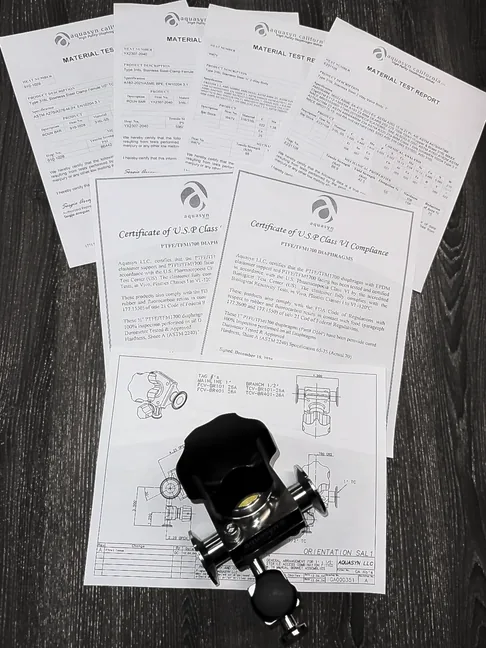
Every Aquasyn valve ships with EN 10204 3.1 material test reports, tracing the 316L back to its mill heat number, as standard and at no extra cost. Additional documentation, including surface finish certificates, welder certificates and weld logs and maps, is available on request at additional cost. If your QA team has a document list, send it with the order so it can be quoted alongside the valves.
Frequently asked questions
What is a documentation pack for a hygienic valve?
It's the set of records that proves a valve matches its specification: the material test report, surface finish and electropolish records, weld records, and elastomer certificates. Validation and audit teams use it for installation qualification and later investigations.
What is the difference between EN 10204 3.1 and 2.2?
A 2.2 test report gives typical results from the supplier's production. A 3.1 inspection certificate gives results from the specific material delivered, validated by the manufacturer's inspection representative independent of manufacturing. For product-contact stainless, 3.1 is the usual requirement.
What does a heat number trace?
The heat number identifies the batch of steel melted at the mill. The material test report records that heat's chemistry and properties, so tracing the number links a component to a specific, tested batch of metal.
What is a weld map?
A drawing of a welded assembly that numbers every weld. Each number links to the weld log entry recording how and by whom that weld was made.
Does USP Class VI certify the diaphragm itself?
It certifies the elastomer compound, based on biological reactivity testing. Check that the certificate names the compound actually supplied.
Do Aquasyn valves ship with material certificates?
Yes. Every Aquasyn valve ships with EN 10204 3.1 material test reports traceable to the mill heat number, as standard. Additional documentation, such as surface finish certificates, welder certificates and weld logs and maps, is available on request at additional cost.
Specify a finish
The configurator states the ASME BPE surface finish designation alongside the Ra value for every finish that carries one.
Open the configurator →