Tank bottom valves.
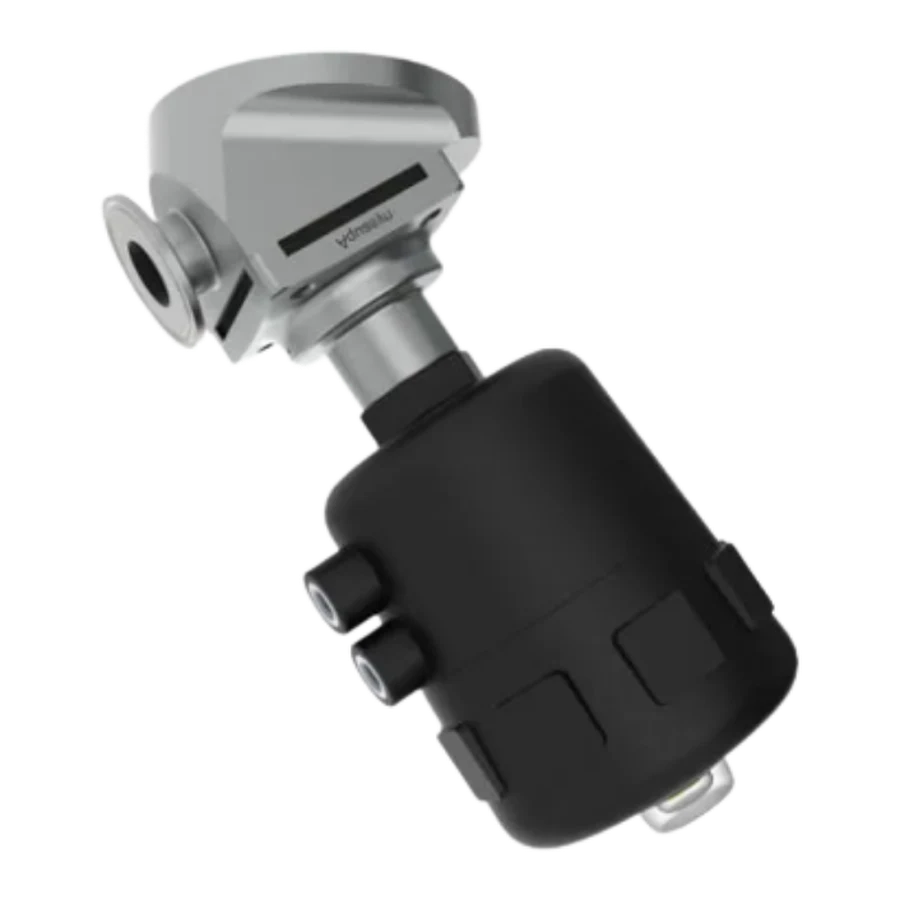
Sanitary tank bottom diaphragm valves that seal at the vessel floor, so a tank drains, harvests and cleans without leaving anything standing. Welded Flange and Tri-Tank styles · ¼" to 4" · machined from 316L bar stock in Carson City.
Welded Flange and Tri-Tank
Two styles, designed in collaboration with customers to address vessel-bottom problems other valves cannot solve. Both machined from 316L bar stock, both engineered to leave nothing stagnant at the bottom of a vessel.
Aquasyn's tank bottom valve range was developed through close collaboration with existing customers to meet system-level needs that off-the-shelf valves consistently miss. The original Welded Flange body has been re-engineered into a more compact unit, with the weir face moved closer to the weld flange and the chamber between weir and flange opened to eliminate stagnant fluid at the vessel bottom. The Tri-Tank variant uses a tri-clamp connection for vessels that need stripping and cleaning between batches.
Which style to specify. Both drain at a 30° outlet angle, so the hygienic behavior is the same. The difference is height and removability. Welded Flange is the volume seller: you cut the hole, weld the valve in, and the body sits tight to the vessel. Tri-Tank is specified when the valve has to come off without breaking a weld, which is a smaller share of installations.
Clearance is usually what decides it. The Welded Flange body is roughly ¾" shorter than the equivalent Tri-Tank, and because the Tri-Tank also hangs a clamp below the vessel, the installed saving at the smallest size works out around an inch. That differential scales with the valve: on a 4" body it is closer to three or four inches of drop. On a low-clearance skid or a tank sitting near the floor, that is often the whole decision.
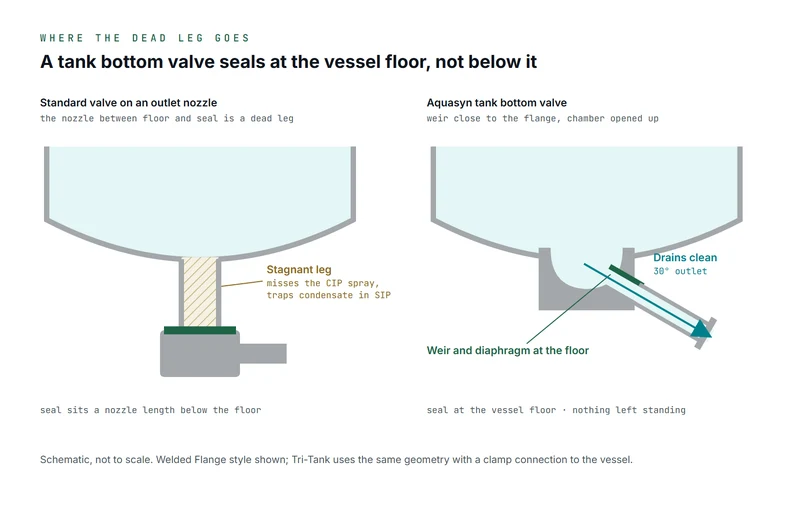
The seal belongs at the floor
A tank bottom valve sits at the lowest point of a vessel to drain product, harvest a batch, take a sample, or let CIP rinse run out. What makes it hygienic is where the seal is.
Put an ordinary valve on an outlet nozzle and the nozzle between the vessel floor and the seal becomes a dead leg. CIP spray doesn't reach it, condensate collects in it during SIP, and product sits in it between batches. Aquasyn tank bottom valves move the weir close to the vessel connection and open up the chamber between them, so the diaphragm seals at the floor and the tank empties completely. Why dead legs and pooled condensate matter is covered in CIP explained and SIP explained.
Where they're used
- Bioreactors and fermenters · drain and harvest
- Media, buffer and product hold tanks
- WFI and purified water storage tanks
- CIP supply and return tanks, and CIP skids
- Mixing and formulation vessels
Fitting a tank bottom valve
Welded Flange. The hole is cut at the vessel's low point and the flange is welded into the head, so the body sits tight to the vessel. It's the shortest stack you can put under a tank, which is why it's the standard choice.
Tri-Tank. The body clamps onto a hygienic clamp connection on the vessel instead of being welded in. Bodies from ¼" to ½" take a 1.5" clamp connection and up; ¾" bodies take 2" and up. Larger bodies are matched to the vessel connection when quoted.
Orientation. Both styles drain through a 30° outlet. Drain-angle marks are etched on the end connections, so the installer can set the outlet pointing downhill toward the drain line by eye. The drain angle table covers Aquasyn's in-line diaphragm bodies.
Clearance. Leave room below the vessel for the bonnet or actuator. Manual, pneumatic and eMaxion™ electric actuation all fit; on a low skid, the Welded Flange body's shorter stack is often what makes the fit work.
Tank bottom valve questions.
What is a tank bottom valve?
What sizes do Aquasyn tank bottom valves come in?
Should I choose a Welded Flange or Tri-Tank tank bottom valve?
What vessel connection does a Tri-Tank valve need?
What materials are Aquasyn tank bottom valves made from?
Can a tank bottom valve be automated?
Where Aquasyn tank bottom valves do the work.
Specified across hygienic processes where stagnant fluid at the vessel bottom or the drain point creates an audit, cleaning, or contamination risk.
Tell us about the vessel.
Welded Flange and Tri-Tank styles, ¼" through 4", machined from bar stock in Carson City. Send the vessel connection, outlet size and actuation, and engineering will quote it directly. Custom connection combinations welcome.